From calculation to planning: retaining knowledge, accelerating work

Krinkels manages green spaces and public outdoor environments across the Netherlands, for municipalities, provinces and Rijkswaterstaat. Craftsmanship is their foundation, innovation their next step.
Context
Krinkels is a leading player in green space management and the design of public outdoor environments, with offices across the Netherlands and operations in several European countries. The company works for clients including municipalities, provinces and Rijkswaterstaat on the maintenance and development of green infrastructure and public space.
The operational process begins with tenders. A estimator determines the execution logic: frequencies, deployment of personnel and machinery, periods. On that basis, Krinkels submits its bid. When the company wins the tender, the project transfers to the works planner, who sets up the annual schedule. Krinkels has eight offices and a large number of staff working directly within this process.

Operational challenge
The handover from calculation to planning was a structural point of loss. During the tendering process, the estimator built up a complete execution logic, pruning cycles per year, machine types, periods, capacity calculations, but at the point of project handover, only the final budget figure remained. The works planner received no insight into the reasoning behind that budget and started the planning process from scratch, without access to the underlying assumptions.
Additional bottlenecks:
- Management had visibility over costs per individual contract item, but not over totals per activity. Insight into what an activity such as “tree maintenance” costs as a whole was structurally absent.
- The entire works preparation process ran through Excel, with manual steps and person-dependent knowledge.
- Seasonal logic and machine scheduling were determined manually for each project, without a standardised methodology.
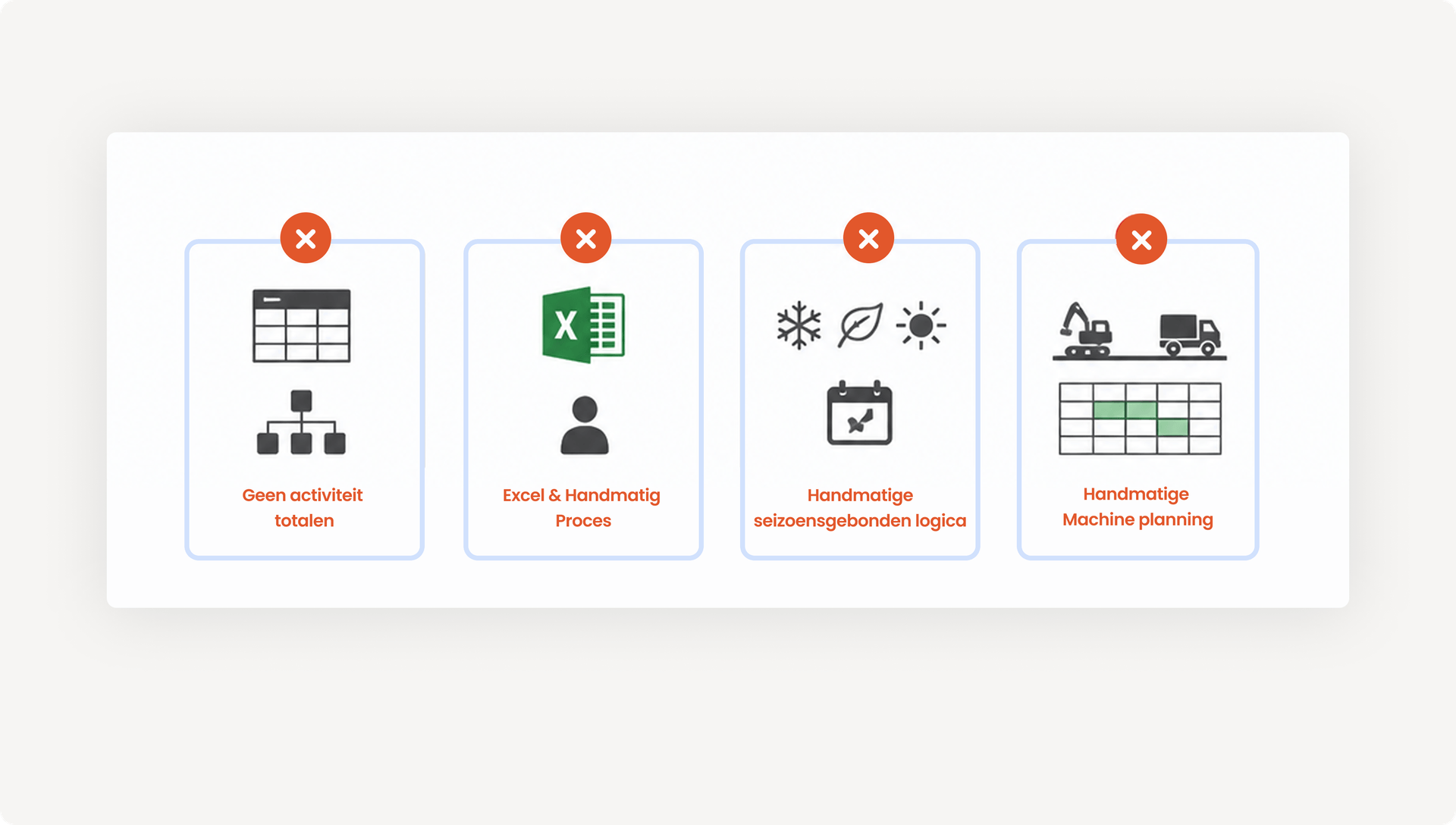
Where value was being lost
The point of loss lay in the handover between calculation and works preparation. Knowledge built up during the tendering phase, knowledge that determined the feasibility of the contract, was not transferable and was not retained. At every project handover, that knowledge was either rebuilt from scratch or remained implicit with a single individual.
Studio Vi’s approach
The existing system (IBIS) and familiar output formats were taken as the starting point. The approach focused on designing an intelligence layer that connects to the existing operational chain, without replacing working methods or raising barriers to adoption.
First, the full process was mapped through a service blueprint session with office managers. This identified the critical handover moments, knowledge dependencies and recurring errors. From that analysis, the team determined which logic could be standardised and where contextual judgement was required.
The architecture combines two approaches: deterministic rule logic for components where execution rules are unambiguous, and an AI model for assignments where contextual understanding is essential. The system is predictable where it needs to be, and adaptive where that adds value.
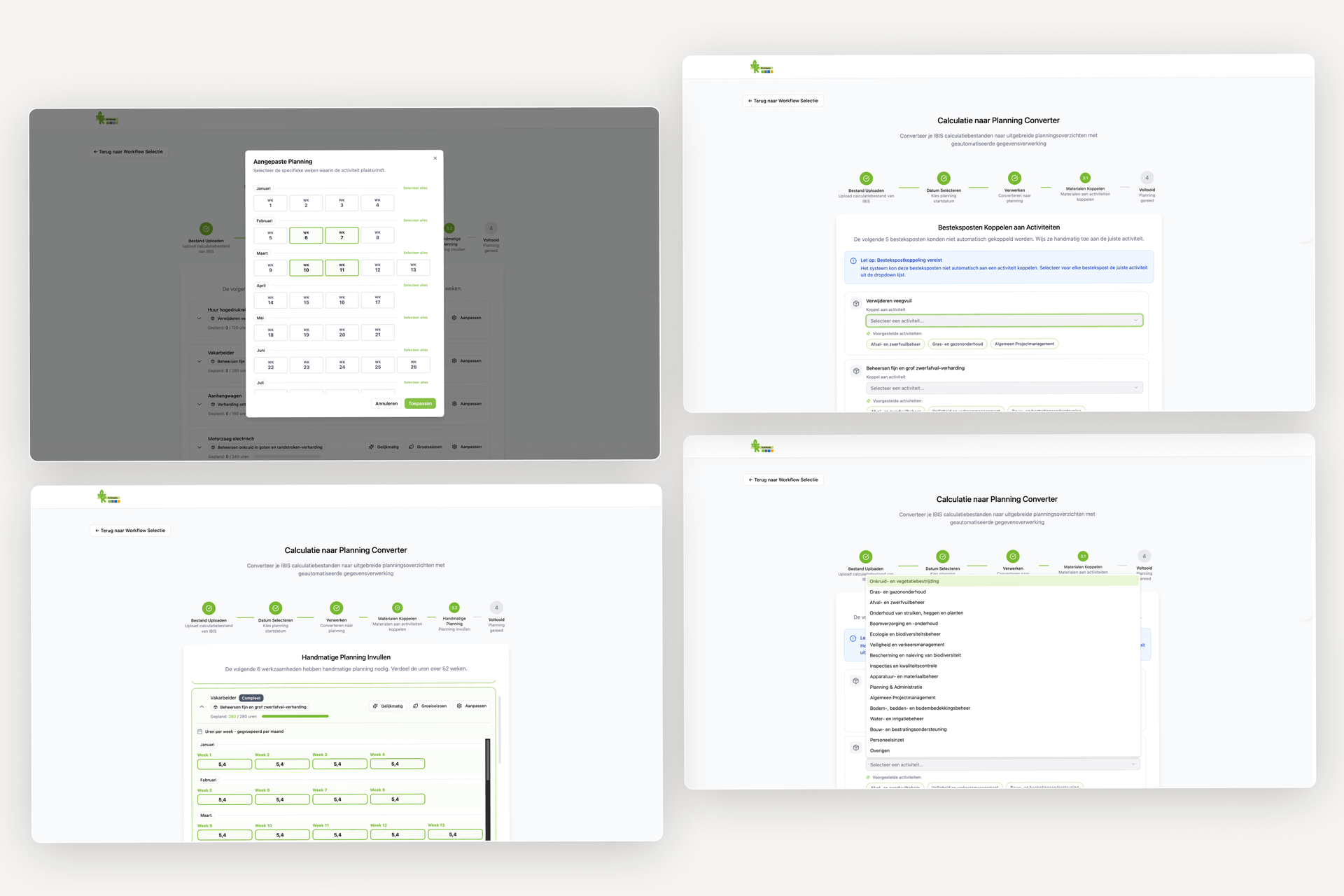
Modules
Planning Intelligence The calculation export from IBIS is automatically converted into an annual schedule in the format Krinkels already uses. Execution logic from the tendering phase, frequencies, periods, capacities, is translated directly into concrete planning weeks. The reasoning behind the budget is no longer lost at project handover.
Activity Cost Intelligence Contract items are automatically assigned to activities, making management insight available at activity level. What an activity costs as a whole is immediately visible, not only on a line-by-line basis.
Seasonal and Capacity Logic Work tied to a specific season is automatically scheduled within the correct period. Capacity assumptions from the calculation are carried through into the planning, without manual translation.
Connected operations
Calculation and works preparation operate from the same knowledge base. The handover between the two functions is no longer a point of loss, but a structured transfer of knowledge. Office managers and works planners work from the same assumptions. Management has visibility at activity level that did not previously exist.
The rollout covers more than fifty staff across eight offices, with a central owner and local points of contact per office.

Operational impact
The pilot has proved its value and is being rolled out to more than fifty staff across Krinkels’ eight offices. Calculation knowledge that was previously lost at project handover is now automatically carried through into the annual plan. Works planners no longer start from zero, they refine an already-built structure. Management has, for the first time, insight into costs at activity level, not only per contract item.
The next phase is the transition from Excel to a platform with a dashboard. Data will flow in in a standardised format, users will have access only to what is relevant to their role, and the foundation will be laid for forecasts and periodicity reports. This module will form the operational foundation for the further digitalisation of works preparation and planning within Krinkels.
“Studio VI is helping us take our first steps in the field of AI. Thanks to the knowledge and dedication of the Studio VI professionals, we are able to automate time-consuming manual work!”
Jan-Willem Horevoorts – Krinkels