What Is the Learning Curve for My Team When Adopting a New Cost Estimation Module?
November 26, 2026Studio Vi

Introducing a cost estimation module may initially appear to be a technical exercise. Install the new software, import the data, and the job is done. In practice, however, the real work only begins afterwards. The module is in place, but the team is not yet using it. Estimators revert to their familiar spreadsheets, exceptions are handled outside the module, and the promised time savings fail to materialise. For many manufacturing companies, the learning curve of a cost estimation module therefore presents a greater challenge than the technical implementation itself. At the same time, it is something that can be considerably shortened with the right approach.
This article provides an honest overview of what to expect, from the initial introduction to the point at which your team has truly mastered the new cost estimation software. Rather than a sales pitch, it offers practical insights to help ensure a smooth adoption process.
What determines how quickly your team adopts the module?
The speed at which a cost estimation tool in the manufacturing industry is adopted depends on more than the complexity of the software. The professional experience and background of your estimators play a significant role. Those accustomed to structured methods and digital tools generally adapt more quickly than colleagues who have relied on their own spreadsheets for years. This is not a criticism, but a reality that should inform the implementation approach.
Several organisational factors also influence the pace of adoption:
- Degree of standardisation in existing workflows: the more consistent the current approach, the easier the transition.
- Quality of training materials and guidance during implementation.
- Management involvement: teams whose managers actively participate tend to learn more quickly.
- Compatibility with existing systems: a module that integrates with familiar data sources makes adoption easier.
- Psychological safety: employees who are allowed to make mistakes whilst learning are more willing to experiment.
The combination of these factors means that the learning curve varies considerably between organisations. This is not a cause for concern, but an indication that a tailored approach is worthwhile.

Daan Ruitenberg Adoptie Lead
Start met AI: plan een demo of doe de AI readiness test.
Typical timescales for each phase of adoption
A realistic cost estimation module implementation progresses through several phases, each with its own timeframe. Understanding these phases helps you avoid setting unrealistic expectations for your team and enables you to make timely adjustments if a phase takes longer than anticipated.
- Orientation and installation (weeks 1–2): The team becomes familiar with the interface, underlying logic and navigation. Productivity temporarily declines, which is normal.
- Initial cost estimates with guidance (weeks 3–5): Employees carry out straightforward calculations with support. Mistakes are made and discussed.
- Working independently on standard projects (weeks 6–10): The module is used for recurring cost estimates. Confidence grows.
- Complex projects and optimisation (months 3–6): The team uses advanced features, adapts models and draws on reusable knowledge from previous projects.
- Full integration (after month 6): The module has become the natural way of working. Teams no longer think in terms of the old method.
When introducing digital cost estimation in manufacturing environments, the transition to phases four and five takes the most time but also delivers the greatest value. Rushing through the initial phases risks superficial adoption, in which the module is used but its full potential remains largely untapped.
Common mistakes that prolong the learning curve
Many organisations underestimate how significantly certain decisions can delay adoption. Technical implementation often progresses smoothly, but the human side falls behind, and this is precisely where problems arise.
One of the most common mistakes is failing to establish clear ownership within the team. If nobody feels responsible for the module, new habits quickly give way to old ones. Estimators who are uncertain revert to their spreadsheets, not because they are unwilling to change, but because spreadsheets feel familiar and the module does not yet. Another pitfall is introducing several changes simultaneously, which divides attention and causes the module to be perceived as an additional burden rather than a solution.
Furthermore, we regularly see training delivered as a one-off, generic exercise. A single introductory session is insufficient to establish lasting change. Effective software onboarding for teams requires repetition, practical exercises and opportunities to ask questions as they arise, rather than weeks later when the context has already been forgotten.
How a good implementation partner accelerates adoption
The choice of implementation partner directly influences the speed and depth of adoption. A partner that only handles the technical installation provides an incomplete service. What makes the difference is a partner that understands your organisation’s workflows and adapts the module to them, rather than the other way round. This also means understanding how cost estimation works in construction, infrastructure or engineering: which project types recur, how contract forms influence the structure of estimates and where estimators currently lose the most time.
Practical ways in which a strong implementation partner can shorten the learning curve include:
- Configuration based on existing project types and contract forms, so that the team immediately recognises familiar ways of working.
- A phased rollout in which complexity is introduced gradually.
- On-the-job guidance rather than classroom-based training.
- Active feedback on initial cost estimates to correct errors quickly.
- Continued availability after go-live to answer questions and make adjustments.
A good partner focuses on outcomes rather than delivered functionality. The question is not whether the module works, but whether the team consistently produces better cost estimates with it.
Signs that your team has truly mastered the module
Full mastery of a cost estimation module is not achieved simply when everyone has read the manual. The difference becomes apparent in everyday working habits, which cannot be imposed but must develop over time.
The following signs indicate successful adoption:
- Employees independently adapt models to new project scenarios.
- Knowledge and outcomes from previous projects are actively reused.
- Cost estimates are no longer maintained separately in spreadsheets alongside the module.
- The team independently identifies opportunities to improve the configuration and proposes adjustments.
- New colleagues are trained by the team itself, without external guidance.
The final point is perhaps the strongest indicator: when the module has become an integral part of how the team shares its knowledge, integration has been fully achieved.
How Studio Vi supports the adoption of a cost estimation module
Studio Vi supports engineering and manufacturing companies in implementing the cost estimation module, from initial configuration through to full team adoption. The approach focuses on tangible results: not merely a functioning module, but a team that consistently produces better cost estimates, with less manual work, improved knowledge retention and greater control over the results.
What Studio Vi offers:
- Tailored configuration based on your project types, contract forms and existing data sources.
- Phased implementation aligned with your team’s workload and pace.
- Practical guidance throughout the adoption process, not just at go-live.
- Integration with existing systems to prevent the module from operating in isolation.
- Consistent and verifiable cost estimates across teams.
Would you like to know what implementation would look like for your organisation? Get in touch to discuss the possibilities without obligation.
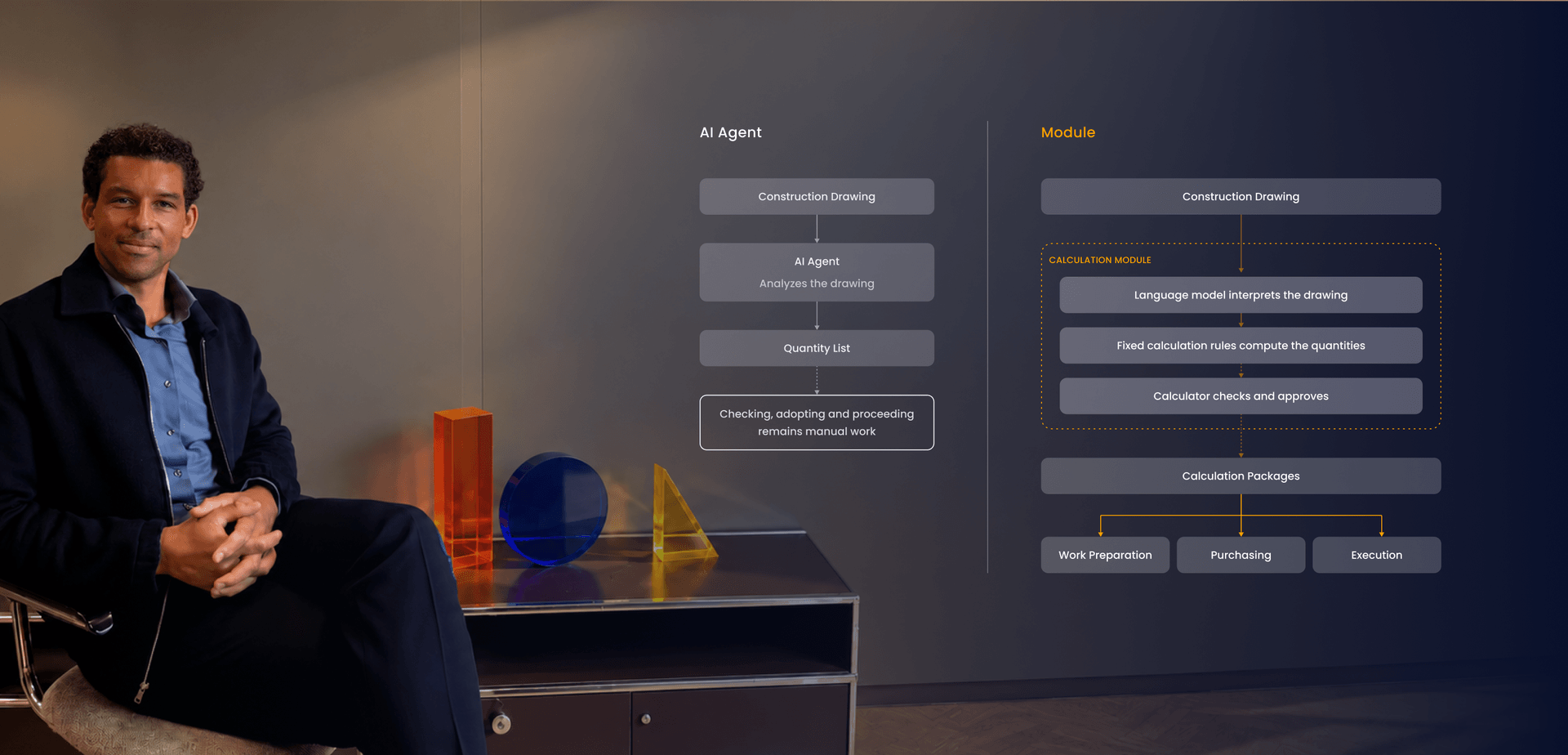
Why we at Studio Vi are building modules, while everyone else is talking about AI agents
AI is making more and more possible. However, what is technically feasible does not necessarily align with what an organisation needs. That is why, at Studio Vi, we adopt a modular approach to intelligence.

AI roadmaps for real estate organizations: how to create momentum
Discover how real estate organizations successfully implement AI with strategic roadmaps. Practical step-by-step plans for returns and efficiency.

What you need to measure in AI projects to demonstrate real impact
Measuring AI projects requires different KPIs than traditional IT. Learn concrete measurement methods for demonstrable impact and ROI.